

I actually counted down the hours.
My fellow SUSS School of Law classmate went one further…

For what it was worth, being a practice trainee was a good experience. It was not the best thing to go through in your 40s. After years of telling others what to do, you are back to being a trainee. However, whatever that was tasked to me, I did to the best of my ability. I felt that the training could have been more structured and at times I was left to figure things out on my own. The second half of my training period consisted of a lot of me having to figure things out. I learned one valuable tip. ELitigation itself is a resource. As you have access to past case files, you are able to see how past submissions were drafted. While I would appreciate a little more guidance, the lack of it at times made me have to improvise. I read countless submissions, be it from my firm or those of opposing counsels. I made a database of phrases and paragraphs of what I think are well drafted submissions.
The 1-year practice training period is too long. Without a proper structure, it is likely that many practice trainees will be subject to merely a longer period of training. Doubling the practice training period does not mean that the trainees will come out better trained. However, it does discourage those who do not have grit and the determination to be called to the bar.
Fortunately for me, I was very determined to get called to the bar.
After a year of being a trainee, this was the document I needed…
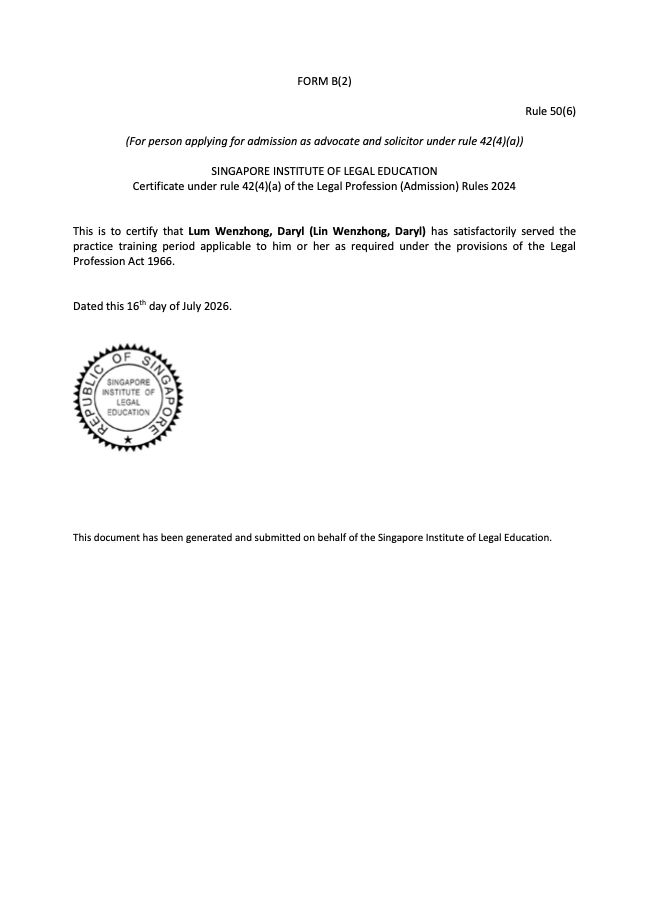
For those who want to know how to get your Form B(2) at the end of your Practice Training period, this portion of my post is for you.
This will be emailed to those who completed their practice training period by SILE.
You will need to submit your Practice Area Checklists, General Practice Training Checklist, Certification of Non-Training Days, Certificate of Diligence, Law Society Course Certificates (namely the Practice Training Advocacy, Ethics in Practice and Legal Profession (Solicitors’ Account) Rules) and your supervising solicitor’s Practicing Certificate(s) during your training period.
It is likely that the Practice Training Advocacy Course would be done sometime after you complete your Part B course. The other two are online courses that you will need to sign up on the Law Society’s website. The online courses can be completed in about two hours each. They consist of lectures and quizzes. They are relatively straightforward and listening to the course would allow you to easily ace the quizzes.
With all of these, you will need to email SILE. They responded to me after four days with Form B(2).
And just like that, my practice training was complete.
Am I staying with the firm I am currently at? No I am not. I told them that I wish not to be retained. I am still with the firm as there are trial upcoming and most of the work were done by me and it would be the responsible thing to help with the preparation of the trial. After that I will be taking a path less travelled but that is perhaps for another blog post. At the moment I am just happy to be done with being a practice trainee.
To those who are still doing their practice, persevere. Your Form B(2) is getting ever closer…
Yours sincerely,
Daryl

Leave A Comment